A GST Writ Was Redirected to Appeal—Then the Supreme Court Added Two Weeks
The Supreme Court upheld the GST statutory appeal route under Section 107 while granting the taxpayer an additional two weeks to file the appeal. The case highlights the importance of alternative remedies, limitation compliance and court-specific extensions in GST disputes.
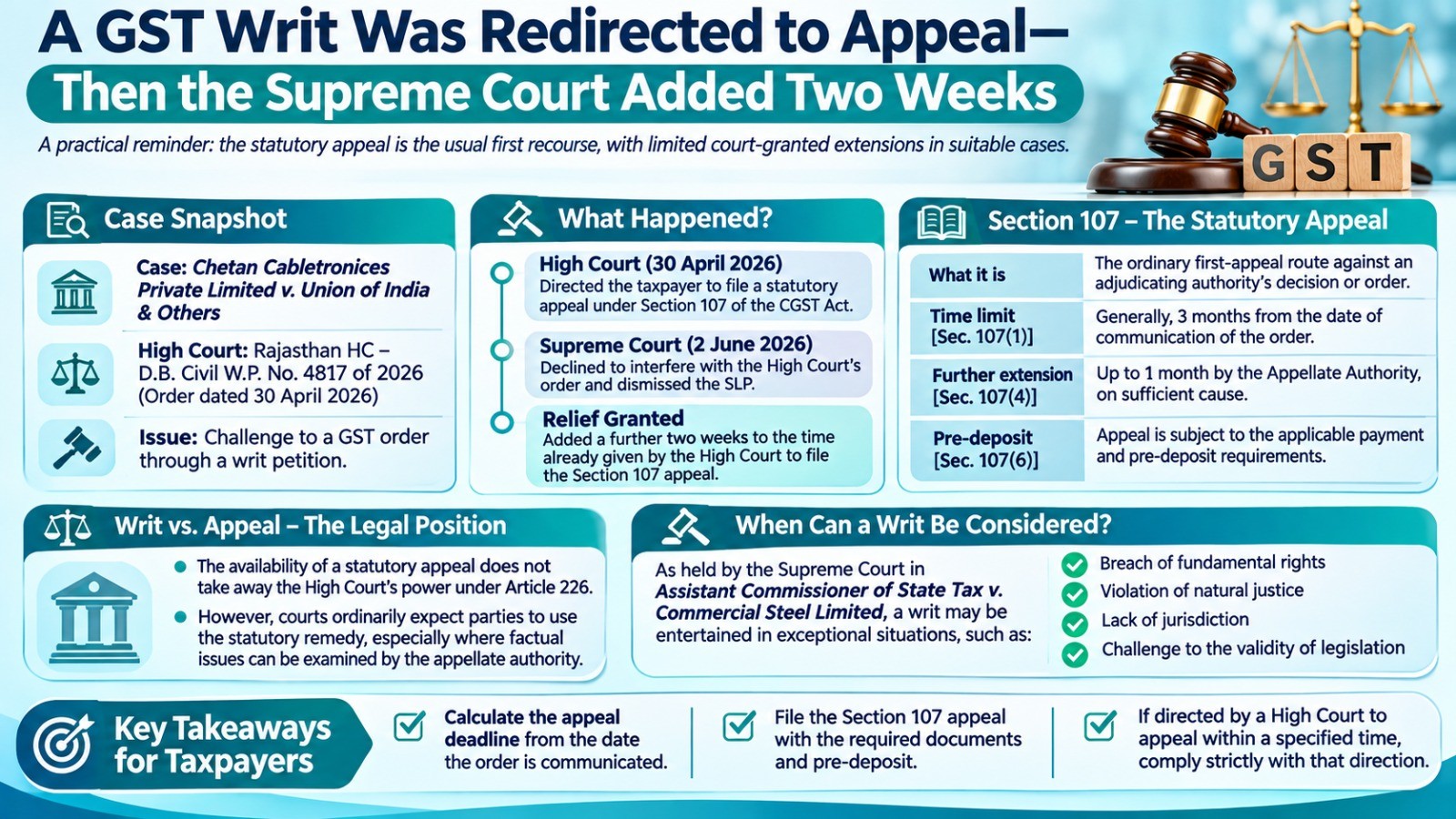
When a taxpayer challenges a GST order, should the dispute begin in the High Court—or follow the appeal route created by the GST law? A recent Supreme Court order offers a practical answer: the statutory appeal will ordinarily be the first recourse, but in a particular case the Court also protected the taxpayer from losing that remedy while the writ proceedings were underway.
In Chetan Cabletronices Private Limited v. Union of India & Others, the Supreme Court considered a Rajasthan High Court order dated 30 April 2026, passed in D.B. Civil Writ Petition No. 4817 of 2026. The High Court had directed the petitioners towards the statutory appeal mechanism under Section 107 of the Central Goods and Services Tax Act, 2017. It granted liberty to appeal within 30 days and directed that, if filed within that period, the appeals should be decided on their merits without the Appellate Authority examining limitation.
The taxpayer approached the Supreme Court. On 2 June 2026, the Court declined to interfere with the High Court’s order and dismissed the special leave petition. However, it added a further two weeks to the time available for filing the Section 107 appeal under the liberty already granted by the High Court. The result was a carefully balanced outcome: the taxpayer was directed to use the statutory forum, while receiving a short, case-specific extension to pursue that remedy.
Section 107 provides the ordinary first-appeal route against an adjudicating authority’s decision or order. Under Section 107(1), an aggrieved person generally has three months from communication of the decision or order to appeal. Section 107(4) permits the Appellate Authority, on sufficient cause, to allow a further period of up to one month. The appeal is also subject to the applicable payment and pre-deposit requirements under Section 107(6). These statutory timelines remain important; the Supreme Court’s additional two weeks arose from its order in this individual matter, not from a general amendment to Section 107.
The order also reflects the relationship between statutory appeals and the High Court’s constitutional jurisdiction under Article 226. The availability of an alternative remedy does not eliminate the High Court’s power to hear a writ petition. But courts ordinarily expect parties to use the remedy provided by the statute, particularly where the dispute involves facts that an appellate authority can examine. In Assistant Commissioner of State Tax v. Commercial Steel Limited, the Supreme Court explained that a writ may still be considered in exceptional situations, including an alleged breach of fundamental rights, violation of natural justice, lack of jurisdiction, or a challenge to the validity of legislation. The existence of an appeal is therefore a strong procedural consideration, not an absolute jurisdictional bar.
For taxpayers, the practical lesson is twofold. First, calculate the appeal deadline promptly from the date the order is communicated and prepare the appeal with the required documents and pre-deposit. A writ petition should not be treated as an automatic substitute for the statutory appeal. Second, where a High Court directs the taxpayer to appeal within a specified period, comply with that direction exactly. The extra two weeks in Chetan Cabletronices should not be assumed to apply to other taxpayers or to revive every time-barred appeal. It was an express, fact-specific direction of the Supreme Court.
The decision is significant because it preserves both procedural discipline and access to a merits hearing. The High Court’s alternative-remedy approach remained undisturbed, while the Supreme Court gave the taxpayer a limited additional window to use the appellate route. For GST disputes, the safest course remains to act within the statutory period—and to rely on an extension only where a court has specifically granted one.