GST ITC Mismatch: What It Means, Possible Consequences and Remedies
A mismatch between ITC claimed in GSTR-3B and credits reflected in GSTR-2A/2B does not automatically establish ineligible credit or fraud. Understand the legal provisions, possible tax, interest and penalty implications, the Supreme Court’s ruling in Tata Steel Limited v. Union of India (2026), and the practical remedies available to taxpayers.
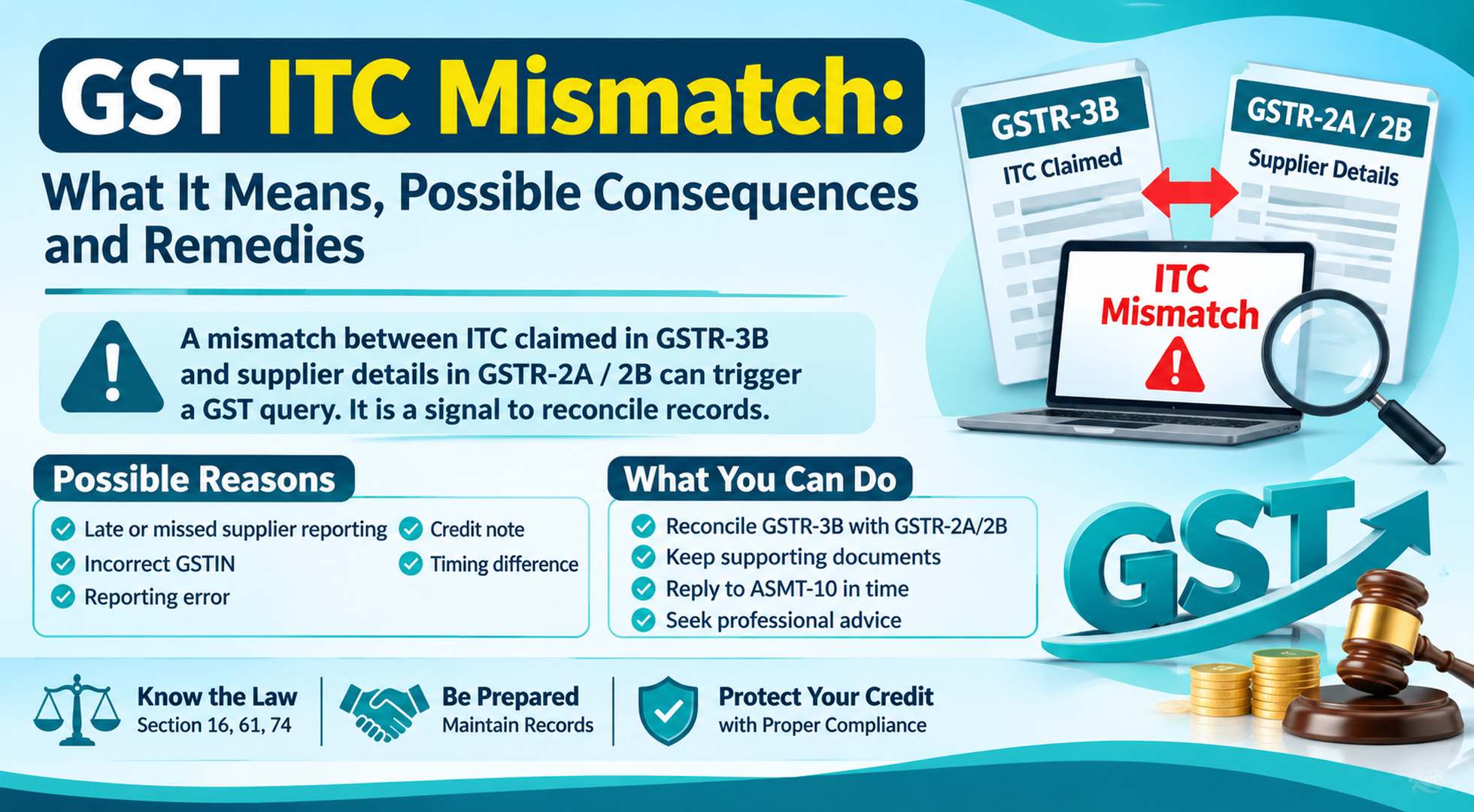
A difference between input tax credit (ITC) claimed in GSTR-3B and the supplier details appearing in GSTR-2A or GSTR-2B can trigger a GST query. It is a signal to reconcile records—not automatic proof that the credit is wrong or that fraud has occurred. Differences may result from late or missed supplier reporting, an incorrect GSTIN, a reporting error, a credit note, or a timing difference. The applicable statement and rules also depend on the tax period.
The starting point is ITC eligibility. A taxpayer should be able to support the credit with the relevant tax document, receipt of the goods or services, business use, supplier reporting and other conditions in Section 16, as applicable to the period. From 1 January 2022, supplier reporting communicated to the recipient through GSTR-2B became a significant statutory condition. Earlier periods had different rules. For specified historical periods, CBIC guidance recognised that supplier-side reporting mistakes could be checked through invoices and other evidence, and in defined circumstances through supplier confirmation or a CA/CMA certificate. That approach is limited to the periods and situations it covers; it is not a blanket entitlement to claim every credit missing from a statement.
A mismatch may first be raised during return scrutiny under Section 61 and Rule 99, commonly through Form GST ASMT-10. This is an opportunity to explain a discrepancy, not by itself a final demand. The taxpayer is generally given up to 30 days to respond, or a further period if allowed. If the explanation is accepted, the officer informs the taxpayer and closes the scrutiny. If it is not accepted, or no response is made, the matter may move to audit, investigation or formal tax-determination proceedings.
If the department ultimately finds that ITC was ineligible, it may seek reversal or recovery of the disputed credit, together with applicable interest and, where legally justified, a penalty. Interest under Section 50(3) concerns ITC that was wrongly availed and utilised; a return mismatch alone does not establish that both conditions are met. Penalty depends on the applicable provision and facts. For periods up to FY 2023–24, Section 74 requires a supported allegation of fraud, wilful misstatement or suppression to evade tax. For FY 2024–25 onward, Section 74A applies and distinguishes ordinary errors from cases involving fraud.
The Supreme Court’s decision in Tata Steel Limited v. Union of India (2026 INSC 920, 25 August 2026) is an important safeguard. The Court held that a mismatch or audit objection, accompanied only by a general assertion of suppression, does not by itself justify Section 74. A notice must state the foundational facts linking the alleged fraud or suppression to the tax shortfall or ITC issue. The Court set aside the notice before it, while leaving room for fresh action in accordance with law and limitation. The ruling does not mean every mismatch is harmless or that otherwise ineligible ITC must be allowed.
A practical response starts with an invoice-by-invoice reconciliation of GSTR-3B, the relevant GSTR-2A/2B statement and the purchase ledger. Identify the reason for each difference and quantify the amount. Keep tax invoices, purchase orders, goods-receipt or service-completion evidence, payment records, e-way bills where relevant, return extracts and communications with suppliers. Ask suppliers to correct reporting errors where possible and preserve proof of follow-up. Check that the credit was not duplicated, reversed elsewhere, blocked or claimed outside the statutory time limit.
Reply to an ASMT-10 within the stated time, normally using Form GST ASMT-11. Explain each category of difference clearly and attach a reconciliation and supporting documents. If only part of the credit is disputed, separate the accepted amount from the contested balance. Do not ignore the notice, but do not reverse credit solely because a portal figure differs before checking eligibility and the relevant period. If a show-cause notice follows, address its specific allegations, calculations, legal section and limitation. Request a personal hearing in writing where needed; Section 75(4) requires an opportunity where requested in writing or where an adverse decision is contemplated.