GST Proceedings Against a Non-Existent Company After Amalgamation
Can GST authorities issue a demand against a company that has ceased to exist following amalgamation? The Bombay High Court clarifies why proceedings against a dissolved entity may be invalid, explains the scope of Section 87 of the CGST Act, and highlights the importance of issuing notices to the correct legal entity.
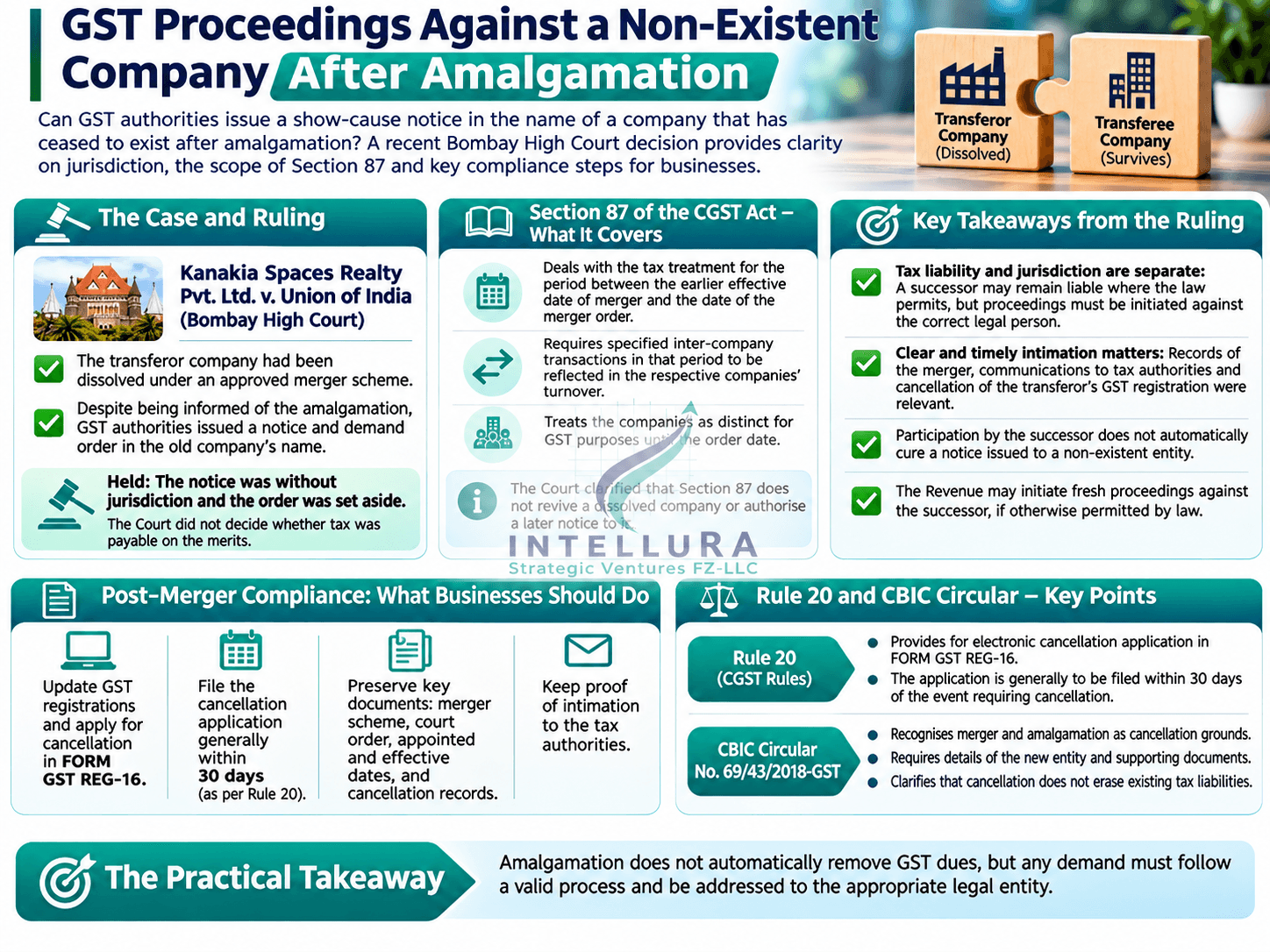
Can GST authorities issue a show-cause notice in the name of a company that has already ceased to exist after amalgamation? The Bombay High Court considered this issue in Kanakia Spaces Realty Pvt. Ltd. v. Union of India. The transferor company had been dissolved under an approved merger scheme, and the authorities had been informed of the amalgamation. Despite this, a GST notice and a consequential demand order were issued in the old company’s name. The Court held that the notice was without jurisdiction and set aside the order. It did not decide whether tax was payable on the merits. 1
Section 87 of the CGST Act addresses tax treatment during the period between an earlier effective date of merger and the date of the merger order. It requires specified inter-company transactions in that interval to be reflected in the respective companies’ turnover and treats the companies as distinct for GST purposes until the order date. The Court clarified that this provision does not revive a dissolved company or authorise a later notice to it. Tax liability and jurisdiction are separate: a successor may remain liable where the law permits, but proceedings must be initiated against the correct legal person. 1 2 3
The case also highlights why clear, timely intimation matters. Records of the merger, earlier communications to tax authorities and the cancellation of the transferor’s GST registration helped establish that the authorities knew the company no longer existed. A successor’s participation in proceedings should not be assumed to cure a notice issued to a non-existent entity. Each matter still depends on the merger terms, effective dates, the entity named in the notice and the communications made to the authorities. The Court left open the Revenue’s ability to initiate fresh proceedings against the successor, if otherwise permitted by law. 1
After a merger, businesses should update GST registrations and preserve the scheme, court order, appointed and effective dates, cancellation records and proof of departmental intimation. Rule 20 provides for an electronic cancellation application in FORM GST REG-16, generally within 30 days of the event requiring cancellation. CBIC Circular No. 69/43/2018-GST recognises merger and amalgamation as cancellation grounds, requires relevant details of the new entity and supporting documents, and clarifies that cancellation does not erase existing tax liabilities. The practical takeaway is balanced: amalgamation does not automatically remove GST dues, but any demand must follow a valid process and be addressed to the appropriate legal entity. 4 5