India’s Startup Landscape in October 2026: Cooler Funding, Bigger Real-World Ambitions
India’s startup ecosystem in October 2026 saw funding moderate to $686 million, while innovation accelerated across AI, robotics, deep tech, space and sustainable solutions. The month highlighted a shift towards commercially viable innovation, where customer adoption, operational reliability, governance and sustainable growth matter more than technology hype.
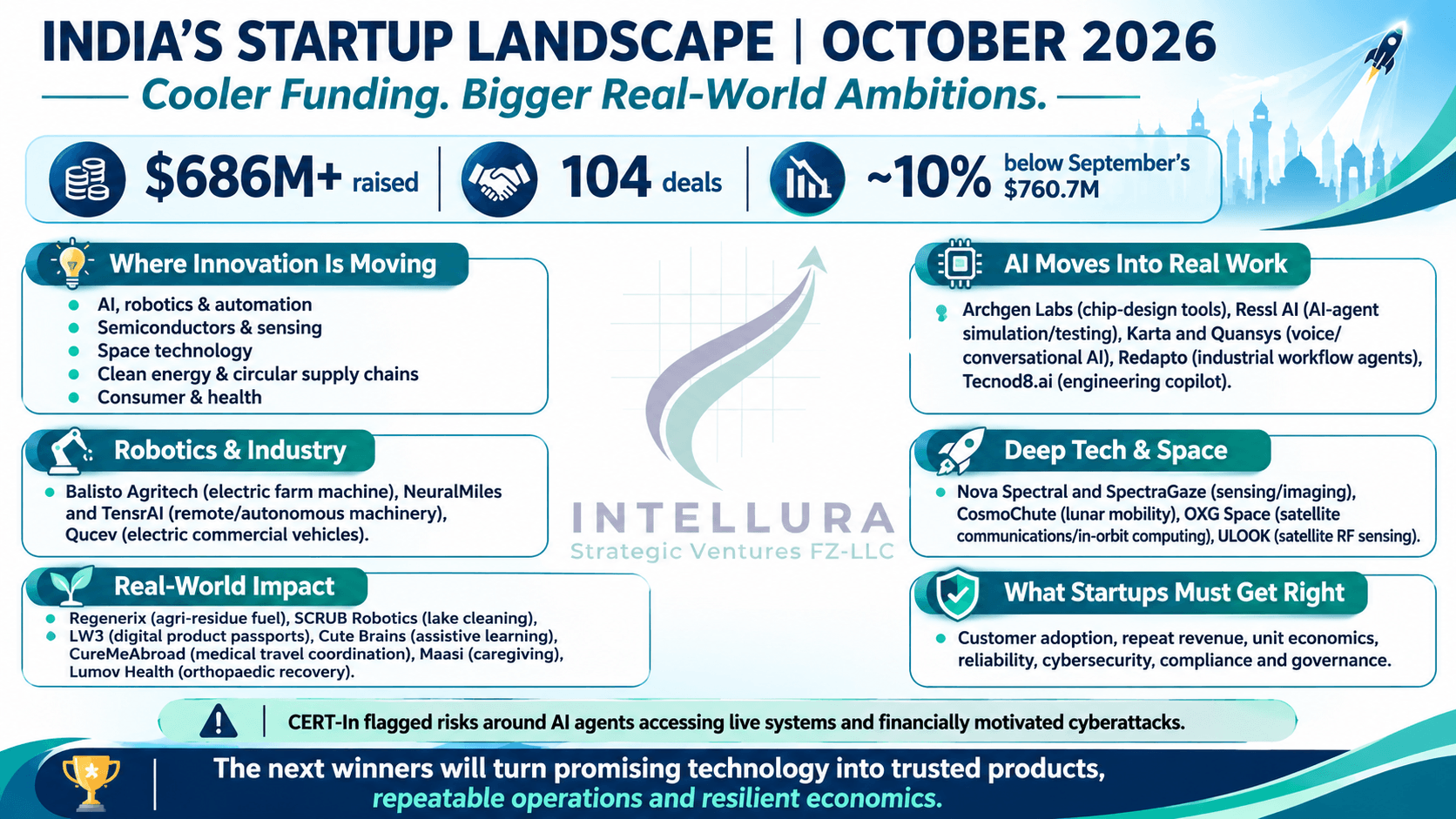
October offered a revealing snapshot of India’s startup ecosystem. Funding moderated, but founders continued to apply artificial intelligence, robotics, advanced materials and connected systems to practical problems in industry, agriculture, healthcare, consumer markets and space. The month’s story is not simply that investment slowed. It is that innovation is being judged increasingly by commercial usefulness, operational reliability and public trust.
Indian startups raised more than $686 million across 104 deals in October, around 10% below September’s $760.7 million. Capital still flowed into AI, deep technology, space, defence, semiconductors and industrial automation. Public markets were active too: four technology-focused companies made their stock-market debuts, while Cult.fit and Atomberg received approvals for proposed IPOs. A more varied funding landscape creates opportunities, but also raises expectations for sound governance, transparent reporting and a credible route to profitability.
AI featured prominently, with several ventures moving beyond general-purpose demonstrations towards defined business tasks. Archgen Labs is developing tools to assist semiconductor engineers with complex chip-design work. Ressl AI is building simulated environments where AI agents can be tested before connecting to live business systems. Its focus reflects an important need: organisations must understand how automated systems behave when they encounter incomplete data, unusual requests or failure conditions.
Other startups are applying AI to customer service and industrial operations. Karta and Quansys are developing voice and conversational AI platforms that can handle customer interactions and execute tasks across business systems. Quansys also offers deployment on a company’s own infrastructure, giving customers greater control over data and models. Redapto is building agents for workflows in manufacturing, logistics and energy, while Tecnod8.ai is developing an engineering copilot for troubleshooting machinery and designing automation. Their shared test is whether they can integrate safely, perform reliably and deliver measurable value after a pilot.
That emphasis on practical deployment extends to robotics and equipment. Balisto Agritech is developing a multipurpose electric farm machine for tasks such as land preparation and weeding. NeuralMiles and TensrAI aim to add remote or autonomous capabilities to machinery already used in industry, construction and mining. Qucev is building electric commercial vehicles, including delivery and heavy-duty models, and offers supporting services such as charging, fleet tracking and after-sales assistance.
Retrofitting existing equipment could make automation more accessible than replacing entire fleets. However, customers will want evidence that new systems reduce downtime, labour or operating costs. Machines must work safely in varied environments, and maintenance support must be available. For these ventures, repeat orders and sustainable unit economics will matter as much as technical demonstrations.
Deep-technology companies face longer development and validation cycles. Archgen’s semiconductor tools, Nova Spectral’s short-wave infrared sensors and SpectraGaze’s imaging systems illustrate efforts to improve chip design and advanced sensing. Nova Spectral remains at the research-and-development stage, while SpectraGaze must convert early projects into repeat business. A prototype is only one milestone: products must meet demanding performance standards, manufacturing must be dependable, and customers must be willing to pay for the solution.
Space ventures are pursuing similarly ambitious goals. CosmoChute is developing reusable lunar mobility systems to transport and protect payloads. OXG Space is working on satellite communications and in-orbit computing, while ULOOK is developing satellite-based radio-frequency sensing to identify signals from ships, aircraft and other systems. These projects may require long testing periods and specialised customers. Planned launches and partnerships are important steps, but commercial success will depend on validated technology, repeat deployments and careful management of capital through development.
A number of startups connect technology with environmental and supply-chain needs. Regenerix is building a model to collect agricultural residue, process it into pellets or briquettes and supply it to industrial buyers as fuel. Its village-level entrepreneur network links field operations to demand from factories. SCRUB Robotics is developing robots for lake cleaning and water-quality monitoring. LW3 is creating digital product passports to record information about battery materials and product lifecycles. Each business depends on coordination among multiple participants, as well as reliable supply and repeat demand.
Consumer ventures are differentiating everyday products and services. The 1970 Shop and Patang are building brands around traditional and regional snacks. Permea is focusing on skincare formulations, while Lorazzo is developing design-led kitchen and bathroom products. Foundry is preparing premium home appliances. These businesses must turn product distinction into customer trust and repeat purchases, while managing costs, distribution and quality as they scale.
Other ventures address health, education and household needs. CureMeAbroad helps patients compare hospitals and coordinate treatment-related arrangements across borders. Cute Brains is developing assistive learning tools for children with dyslexia and dysgraphia, alongside school assessments and teacher training. Maasi connects families with trained caregivers, while Lumov Health makes orthopaedic recovery products. Digital platforms can improve discovery and coordination, but outcomes depend on qualified partners and consistent service delivery.
October also showed how growth increases responsibility. CERT-In flagged risks involving AI agents accessing live systems during testing and the use of agentic tools in financially motivated cyberattacks. Separately, weak private keys associated with digital certificates led major technology platforms to distrust affected certificates. Proposed insurance commission caps also prompted concerns among distributors and brokers. Cybersecurity, regulatory readiness and governance therefore belong in the operating model from the outset, not only after a business has become large. Startups handling sensitive data or automating important decisions need access controls, testing, incident response and accountability.
For founders, progress should be measured beyond market size or product novelty. Customer adoption, repeat usage, gross margins, cash needs, reliability and compliance readiness help show whether an idea is becoming sustainable. Investors should assess reported growth alongside revenue quality, customer concentration, technical validation and the time and capital required to scale. A large addressable market signals potential, not guaranteed demand or profitability.
October’s funding total was lower than September’s, but the range of ideas remained striking. From AI evaluation and industrial automation to lunar infrastructure, cleaner energy, assistive education and regional consumer brands, startups are pursuing demanding problems. The next stage will favour businesses that translate promising technology into trusted products, repeatable operations and resilient economics.