Mistaken GST Cash-Ledger Deposits: When Can You Claim a Refund—and Interest?
Can you claim a refund of mistaken GST deposits in the Electronic Cash Ledger, and when does interest become payable? Explore the Delhi High Court’s ruling on delayed GST refunds, the 6% interest awarded, and the practical steps to recover excess cash-ledger balances.
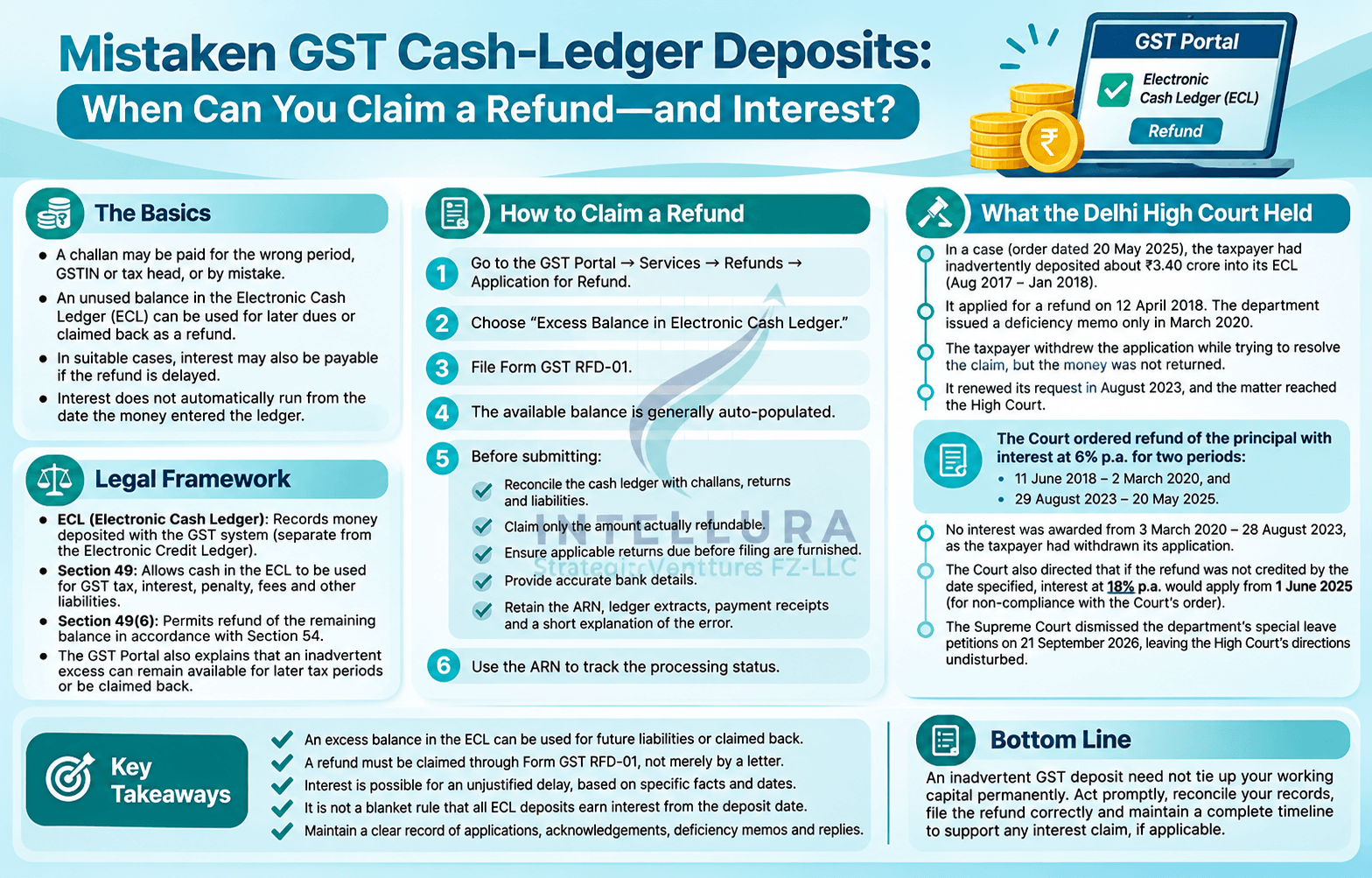
An accidental GST deposit can tie up working capital. A challan may be paid for the wrong period, GSTIN or tax head, or a business may deposit money before understanding how the GST ledger works. Many taxpayers assume that once cash reaches the GST portal, it can only be used against a future liability. That is not necessarily true. An unused balance in the Electronic Cash Ledger (ECL) can generally be used for later dues or claimed back as a refund. In suitable circumstances, interest may also be payable if the refund is delayed. But interest does not automatically run from the date the money first entered the ledger.
The ECL records money deposited with the GST system. It is distinct from the Electronic Credit Ledger, which records input tax credit. Section 49 allows cash in the ECL to be used for GST tax, interest, penalty, fees and other liabilities. A deposit is not, by itself, a payment against a particular liability; the ledger must be debited for that purpose. After applicable dues are paid, Section 49(6) allows the remaining balance to be refunded in accordance with Section 54. The GST Portal likewise explains that an inadvertent excess can remain available for later tax periods or be claimed back.
A refund claim should be made through the prescribed process, not merely by writing to the tax office. On the GST Portal, select Services → Refunds → Application for Refund, choose “Excess Balance in Electronic Cash Ledger,” and file Form GST RFD-01. The available balance is generally auto-populated. Before submitting, reconcile the cash ledger with challans, returns and liabilities; claim only the amount actually refundable; and confirm that the applicable returns due before filing have been furnished. Provide accurate bank details and retain the ARN, ledger extracts, payment receipts and a short explanation of the error. The ARN allows the taxpayer to track processing.
The interest question was examined in a Delhi High Court order dated 20 May 2025. The taxpayer had inadvertently deposited about ₹3.40 crore into its ECL between August 2017 and January 2018. It applied for a refund on 12 April 2018. The department issued a deficiency memo only in March 2020. The taxpayer then withdrew the application while trying to resolve the claim, but the money was not returned. It renewed its request in August 2023, and the dispute eventually reached the High Court.
The Court ordered a refund of the principal with interest at 6% per annum for two periods: 11 June 2018 to 2 March 2020, and 29 August 2023 to 20 May 2025. The first period began sixty days after the original refund application. The Court did not award interest from 3 March 2020 to 28 August 2023, particularly because the taxpayer had withdrawn its application. It also directed that if the refund was not credited by the date specified in the order, interest at 18% per annum would apply from 1 June 2025. That 18% rate was a consequence of non-compliance with this particular court order. It is not the usual rate for every delayed ECL refund.
The decision should not be reduced to the claim that all money deposited into the ECL earns interest from the deposit date. The High Court considered a refund claim that had remained unresolved for years and applied the statutory delay framework to the particular filing and follow-up dates. The taxpayer’s withdrawal of its first application also affected the interest period. The Supreme Court dismissed the department’s special leave petitions on 21 September 2026, stating that it found no good ground to interfere. This left the High Court’s directions undisturbed in that dispute; the brief order did not set out a separate, detailed rule for every cash-ledger refund claim.
For a business that has made an accidental deposit, the practical response is to act promptly and keep a clear record. Check whether the amount remains in the ECL and whether it is under the correct tax head. Reconcile challans, ledger entries, returns and any outstanding dues. Decide whether the funds should be used against future liabilities or claimed back. If a refund is sought, file RFD-01 under the correct category, attach relevant records, verify bank details and save the ARN. If processing is delayed, preserve the complete application, acknowledgements, deficiency memos, replies and later correspondence. Those dates may determine whether interest is claimable and for which period.
An inadvertent cash-ledger deposit need not become a permanent loss of working capital. The law provides a route to recover unused funds, and the Delhi High Court’s decision demonstrates that an unjustified delay in refunding them can have an interest consequence. The key is to distinguish the right to get an excess balance back from the separate, fact-dependent right to interest. A properly reconciled ledger, a correctly filed refund application and a reliable timeline make that distinction easier to establish.