Search Powers, Client Privilege and the Facts That Matter
A GST search at an advocate’s office raises important questions about the limits of statutory search powers and the protection of privileged client communications. In Puneet Batra v. Union of India, the Delhi High Court and subsequent Supreme Court proceedings highlight the balance between lawful investigation under Section 67 of the CGST Act and advocate–client confidentiality under Section 132 of the Bharatiya Sakshya Adhiniyam.
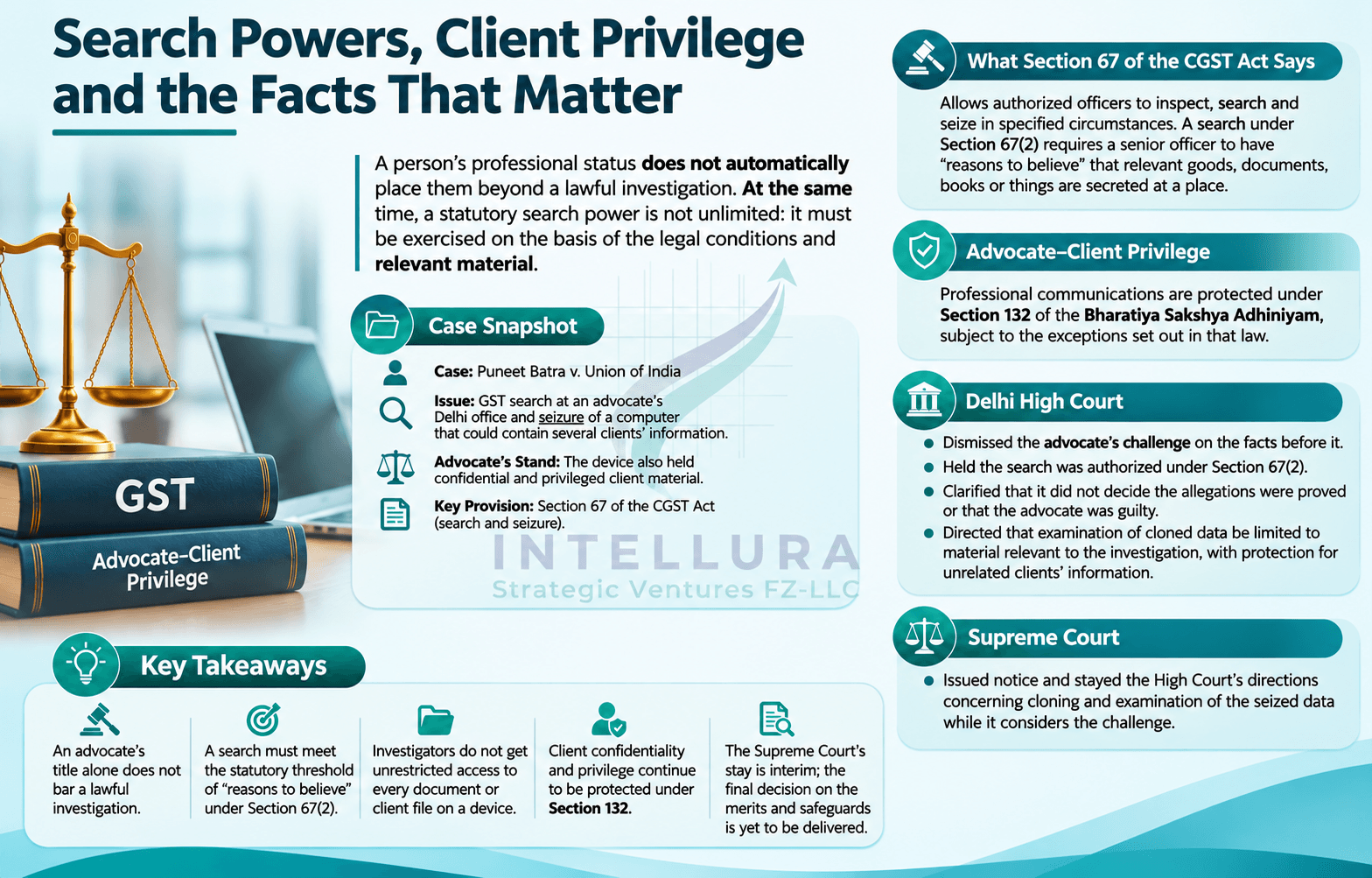
A person’s professional status does not automatically place them beyond a lawful investigation. At the same time, a statutory search power is not unlimited: it must be exercised on the basis of the legal conditions and relevant material. This balance arose in Puneet Batra v. Union of India, concerning a GST search at an advocate’s Delhi office and the seizure of a computer that could contain information relating to several clients. The investigation concerned the advocate’s alleged role in a company’s affairs; the advocate argued that the device also held confidential and privileged client material.
Section 67 of the CGST Act permits authorized officers to inspect, search and seize in specified circumstances. For a search under Section 67(2), the statutory threshold includes a senior officer having “reasons to believe” that relevant goods, documents, books or things are secreted at a place. The question is therefore not simply whether the person is an advocate, but whether the statutory basis exists and whether the items sought are connected to the investigation. Equally, a search does not give investigators unrestricted access to every document or client file found on an electronic device.
The Delhi High Court, in its judgment dated 18 September 2026, dismissed the advocate’s challenge on the facts before it, concluding that the search had been authorized under Section 67(2). It treated the legality of the search as distinct from the protection owed to particular client communications. The Court did not decide that the allegations were proved or that the advocate was guilty. It also made clear that the judgment should not be read as removing advocate–client privilege or permitting unrestricted searches of lawyers’ offices. Its directions sought to limit examination of cloned data to material relevant to the investigation and protect unrelated clients’ information. Professional communications are protected under Section 132 of the Bharatiya Sakshya Adhiniyam, subject to the exceptions set out in that law.
The advocate challenged the High Court judgment before the Supreme Court. On 28 September 2026, the Supreme Court issued notice and stayed the High Court’s directions concerning cloning and examination of the seized data while it considers the challenge. The interim order is not a final ruling that the search was illegal; the merits and safeguards for reviewing the seized material remain for the Court to consider. The case is a reminder that neither an advocate’s title alone nor an investigation alone resolves the issue: the authority must meet the statutory threshold, and the process must carefully distinguish relevant evidence from protected or unrelated client information.