Section 245D(4) Settlement and Section 148 Reassessment: When Finality Applies
Can the Income Tax Department reopen an issue already concluded by the Income Tax Settlement Commission? In ACIT v. Omaxe Limited, the Supreme Court reaffirmed that Section 245-I protects the finality of settlement orders, preventing reassessment under Sections 147 and 148 on matters already considered and settled, subject to statutory exceptions.
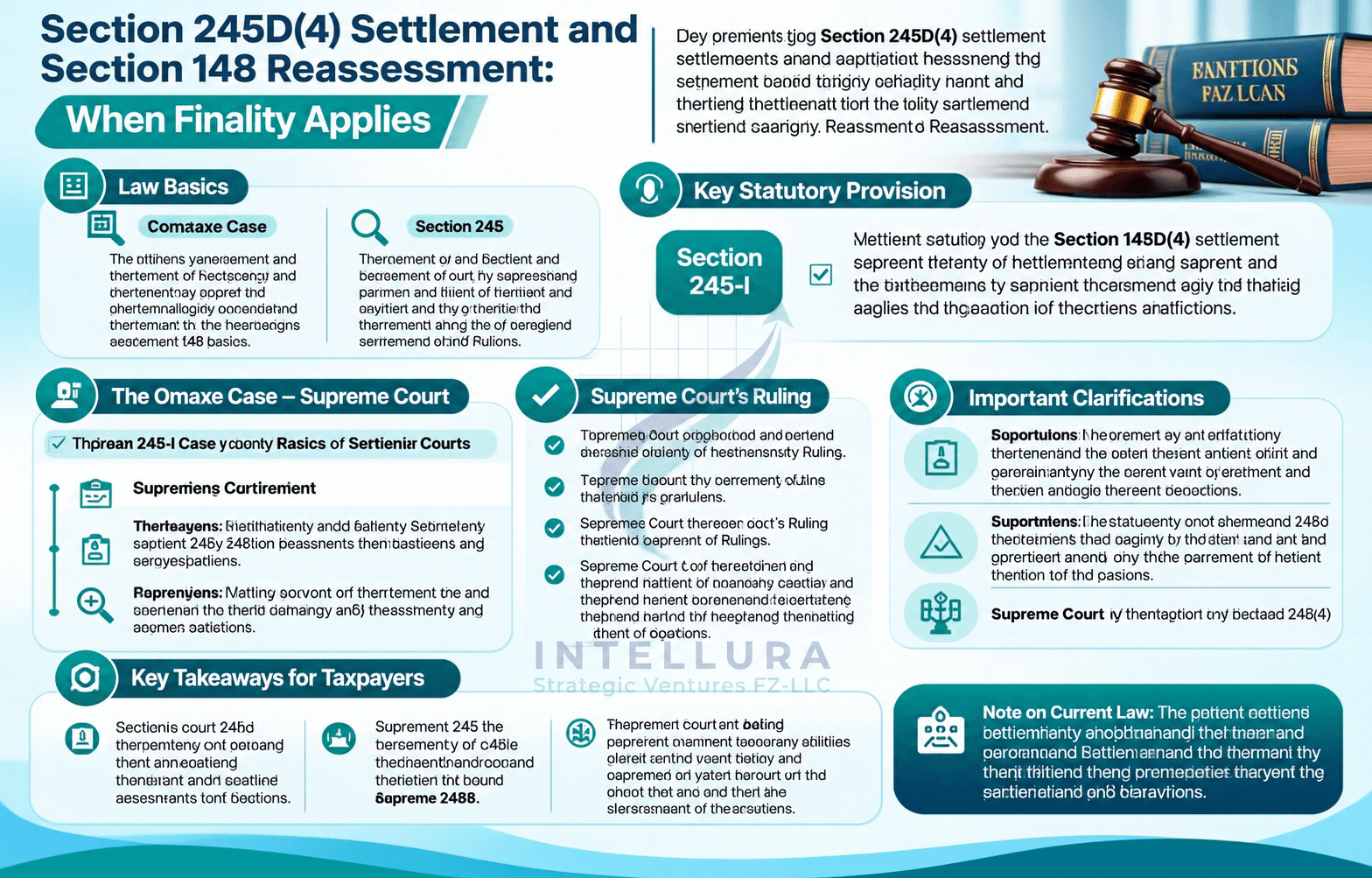
Under the Income-tax Act, 1961, Section 245D (4) empowered the Income Tax Settlement Commission to pass a final order after considering the settlement application, records and tax department’s report. The order settled the matters before it and determined the resulting tax liability. Section 148 served a different purpose: it enabled an Assessing Officer to issue notice to begin reassessment under Section 147 where income was believed to have escaped assessment, subject to statutory conditions and procedure. The question is whether that ordinary route can reopen an issue already settled.
The answer is found in Section 245-I. It makes an order under Section 245D (4) conclusive on matters stated in it and bars those matters from being reopened in another proceeding under the Act, subject to Chapter XIX-A’s specific exceptions. Accordingly, Section 148 cannot be used as a second round of assessment on an issue the Commission has considered and settled. This protection applies to matters actually covered; the order and record determine its scope.
The Supreme Court applied this principle in Assistant Commissioner of Income Tax v. Omaxe Limited. For AY 2006–07, the Settlement Commission’s final order calculated taxable income after taking account of a deduction claimed for housing projects. Following a later survey, the Department alleged the projects did not qualify and issued a Section 148 notice seeking to reopen the year.
The Court found the deduction was part of the settlement on those facts: it appeared in the computation before the Commission, the Commission determined net taxable income on that basis, and the Department had participated. The Assessing Officer could not use Sections 147 and 148 to disturb the concluded issue. The Supreme Court upheld the quashing of the reassessment and dismissed the Department’s appeal, explaining that ordinary reassessment powers cannot defeat the finality Parliament attached to settlement orders.
Finality is not absolute. Under Section 245D (6) the Commission may declare a settlement void if it finds that it was obtained by fraud or misrepresentation; the statutory consequence may restore regular assessment proceedings. In Omaxe, the Department had invoked this route, but the Commission rejected the allegation and that decision became final. The Department could not bypass it by reopening the issue under Section 148. Limited constitutional judicial review remains available.
For taxpayers, compare any later notice with the settlement order, application, computation and material considered by the Commission. If the notice revisits the same settled matter, these records may support an objection under Section 245-I. Omaxe is not a blanket bar on reassessment of every item for that year: the outcome depends on whether the matter was covered or the settlement has been lawfully set aside. The ruling concerns a legacy assessment year; the Income Tax Department’s transition guidance confirms the 1961 Act continues to govern pending proceedings and proceedings relating to tax years beginning before 1 April 2026.