When a Minor’s Income Is Clubbed with a Parent, Who Should Receive the Reassessment Notice?
The Madras High Court in Liya Acharya (Minor) v. Union of India held that reassessment proceedings cannot be validly initiated against a minor when the income is required to be clubbed with the parent’s income under Section 64(1A) of the Income-tax Act, 1961. The ruling reinforces the importance of identifying the correct assessee in reassessment proceedings while preserving the Department’s right to initiate appropriate action against the parent in accordance with law.
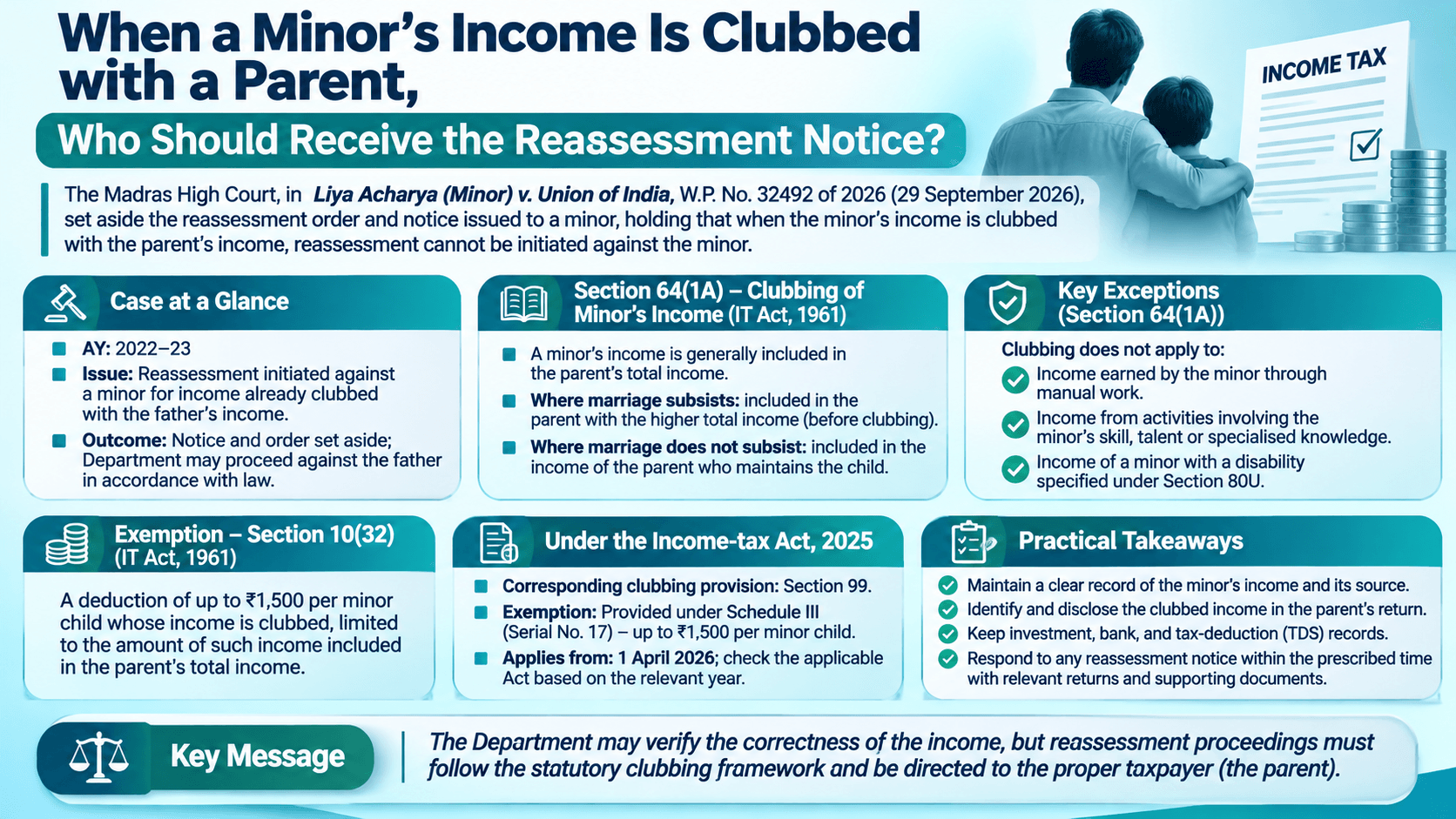
Income earned by a minor may, in specified circumstances, be included in a parent’s taxable income. This raises an important procedural question: if the same income has already been clubbed with a parent’s income, should reassessment proceedings for that income be initiated against the child? In Liya Acharya (Minor) v. Union of India, W.P. No. 32492 of 2026, decided on 29 September 2026, the Madras High Court considered this issue and set aside the reassessment order and notice issued to the minor. The Court left the Department free to take appropriate action against the father in accordance with law.
The matter concerned Assessment Year 2022–23 and mutual fund investments of about ₹1.97 crore in the minor’s name. The father explained that the investments came from earlier mutual fund redemptions and that the relevant gains had been included in his return under Section 64(1A) of the Income-tax Act, 1961. The Department accepted that a minor’s income could be clubbed with a parent’s income, but raised a concern that the minor’s figures had not been separately identified in the father’s computation. The Court held that, on the admitted facts, reassessment against the minor was not tenable. The decision did not prevent the Department from examining the income or pursuing proceedings against the parent were permitted by law.
For years governed by the 1961 Act, Section 64(1A) generally required a minor child’s income to be included in the income of the parent whose total income, before clubbing, was higher. If the parents’ marriage did not subsist, the income was generally included with the income of the parent who maintained the child. The rule did not apply to income earned by the child through manual work or activities involving the child’s skill, talent, specialised knowledge or experience. It also excluded income of a minor with a disability specified under Section 80U.
Under the 1961 Act, Section 10(32) allowed an exemption of up to ₹1,500 for each minor child whose income was clubbed, limited to the amount of income included. For tax years governed by the Income-tax Act, 2025, the corresponding clubbing provision is Section 99. It retains the broad parent-selection rule and exceptions, while the exemption is set out in Schedule III. The 2025 Act came into force on 1 April 2026, so the statute applicable to the relevant year must be checked. The Madras case concerned AY 2022–23 and was decided under the 1961 Act.
The practical lesson is to keep a clear trail of the minor’s income, its source, the amount included in the parent’s return and the related tax or tax-deduction records. If a reassessment notice is issued to a minor for income said to have already been clubbed, the family should respond within the prescribed time and provide the relevant returns, computations and supporting documents. The ruling is fact-specific, not a blanket exemption from tax scrutiny: the Department may verify whether income was fully and correctly reported, but proceedings must follow the statutory clubbing framework and be directed to the proper taxpayer.