AI Spending Is Surging: How Should Founders Prove the Return?
AI spending is soaring, but how can founders turn massive investments into measurable returns, protect cash flow, and prove real business value to investors?
By CA Aswin
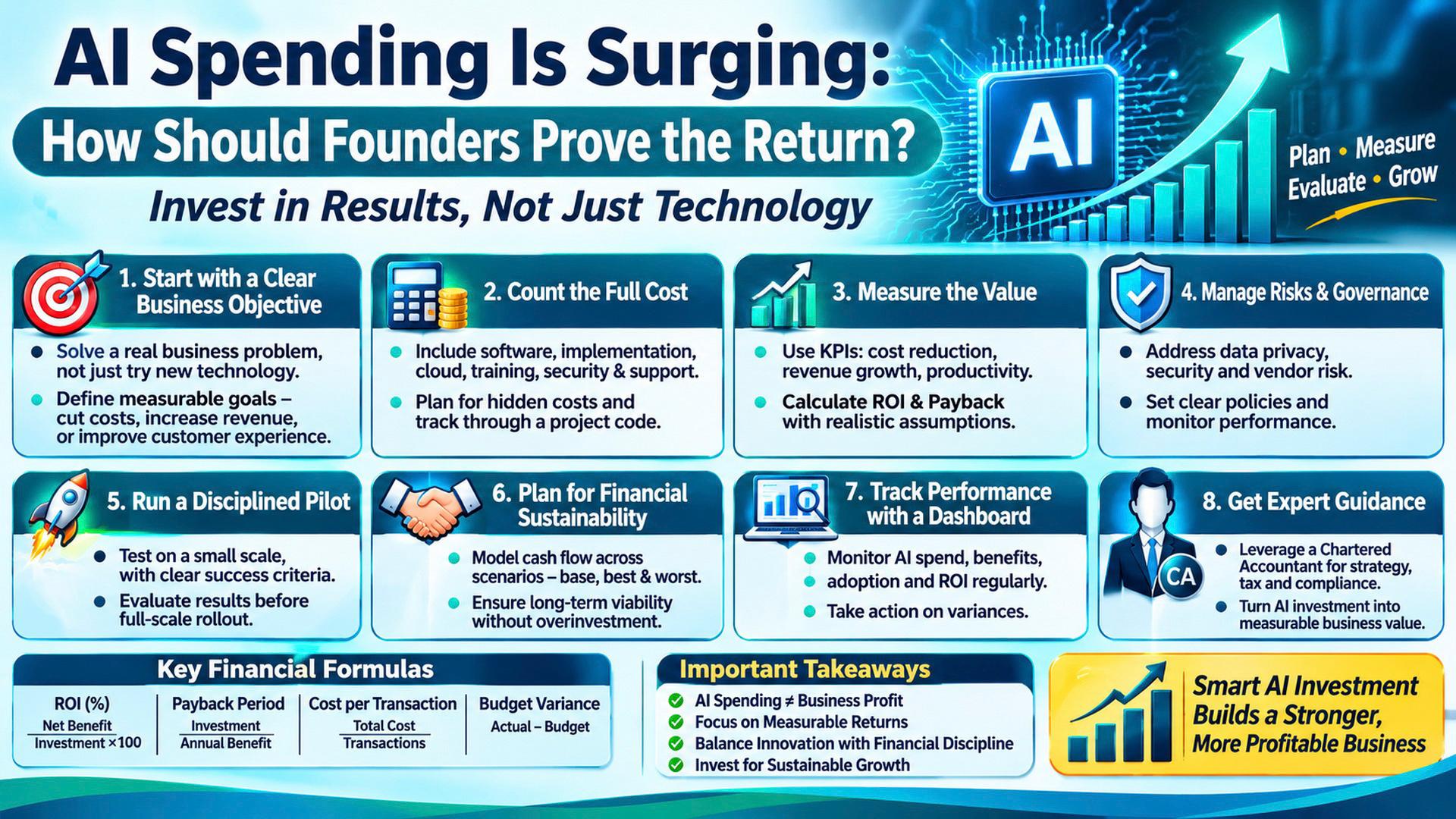
Artificial intelligence is attracting extraordinary investment, but a large technology budget is not, by itself, proof of business value. Reuters reports that AI-related spending is expected to exceed US$730 billion in 2026 as demand for computing infrastructure expands and technology companies consider additional fundraising.
From a Chartered Accountant’s perspective, the AI investment should connect strategy to budgets, cash forecasts, accounting records and measurable outcomes. Whether building an AI product or adopting one, management should compare expected customer value, revenue, productivity gains or risk reduction with full implementation cost. Keep evidence for assumptions so reported returns can be reconciled to operating and financial data for board review.
Start with the business problem
An AI investment should begin with a defined business problem, not a technology demonstration. “We want to use generative AI” is not an investment objective. “We want to reduce the time needed to resolve a support request without lowering customer satisfaction” is testable. So is improving demand forecasts to reduce stock-outs.
Before introducing a system, record the process’s current cost, time, quality and volume. A support team might track average handling time, cost per resolved ticket, repeat contacts and customer satisfaction. Without a baseline, normal fluctuations or workload changes can be mistaken for AI-driven improvement.
Count the full cost
AI costs extend beyond a licence. Include implementation and integration, data preparation, cloud or model usage, security reviews, staff training, monitoring and maintenance. Count the human time required to review outputs and correct errors. Where a system changes a core workflow or requires specialist support, include those resources as well. Classify implementation, development and subscription costs under the applicable accounting framework; capitalisation depends on the facts and is not automatic. Assign a project code so actual spend can be compared with budget and forecast.
A small pilot can appear inexpensive, while broad adoption increases usage charges, support needs or infrastructure requirements. Model cost per transaction, customer or active user at different adoption levels. If usage costs grow faster than revenue or savings, scaling could weaken the economics. Also identify commitments that are hard to reverse, such as minimum usage, multi-year contracts or dedicated infrastructure.
Measure value in business terms
Choose return measures that reflect the company’s business model. An operational use case may lower cost per transaction, shorten processing time or allow the same team to handle more work. A customer-facing product may increase conversion, retention or revenue per customer. A risk-control application may reduce error rates or losses.
Connect operational improvement to financial value. If AI saves employee time, determine whether that time reduces overtime, delays hiring, increases service capacity or is redirected to more valuable work. Hours saved are not automatically cash savings. For example, do not claim both the full value of labour hours saved and the revenue generated when those same hours are redeployed.
A finance review should compare incremental cash benefits with investment and operating costs over the same period, then test the payback period and return under realistic assumptions. Record the measurement window, adoption rate, expected effect and cost categories. Separate realised savings or revenue from indirect benefits, and reconcile reported results to source records.
Run a disciplined pilot
A pilot should test performance under real operating conditions. Define the user group, task, duration and success threshold in advance. Compare outcomes with the baseline or an appropriate control group. Include quality measures.
Before launch, decide what evidence would justify scaling, modification or discontinuation. If the pilot misses its target, identify whether the cause is the model, data, workflow, training or choice of use case.
Adoption must also be tested. Employees may avoid a tool that adds steps or produces inconsistent results. Customers may not value a feature simply because it uses AI. Usage, repeat use, completion and feedback help show whether projected benefits are achievable at scale.
Stress-test the economics and cash plan
Assess more than one scenario. A base case can use expected adoption and costs. A downside case might assume slower uptake, higher computing prices, additional review or lower willingness to pay. An upside case may reflect faster scaling, but should not be the only case used to secure funding. Identify assumptions that most affect payback and monitor them as evidence accumulates.
Cash flow matters because expenditure often comes before benefits. A company may pay for data preparation, integration and infrastructure months before a product generates meaningful revenue. Forecasting the timing of both payments and benefits helps founders estimate runway and avoid commitments that require repeated fundraising before the use case is proven. Staged investment, with more budget released after evidence-based milestones, can preserve flexibility.
S&P Global Ratings expects six major hyperscalers to have negative free operating cash flow in 2026 and 2027, with recovery not projected until 2029. This forecast concerns large infrastructure companies, not typical startups. Founders should not copy large platforms’ spending scale; their financing capacity should match the time needed to establish evidence of product-market fit and sustainable economics.
Include risk and governance
An AI system can create losses if it produces inaccurate outputs, exposes confidential data, infringes third-party rights or becomes unavailable. Identify the data being used, who can access outputs, how results are reviewed and what happens when the system fails. Consider vendor dependence, data portability and the ability to switch providers. These controls take resources, so include them in the cost and risk assessment from the start.
A reduction in operating expense may not create value if it introduces unacceptable legal, security or reputational exposure. Assign clear responsibility for system performance and monitor it in proportion to the use case. Higher-impact decisions may need more human review and documentation than low-risk internal assistance. The aim is not to eliminate all risk, but to understand which risks could change the expected return and how they will be managed.
Make the case investor-ready
Investors and boards need a clear line from capital invested to evidence produced. A concise update can describe the use case, baseline, budget versus actual spend, measurable outcome, adoption level, quality indicators and next milestone. Distinguish actual results from forecasts, explain changes in assumptions and retain supporting records. If benefits are still developing, report leading indicators without presenting them as realised profit.
The market’s spending estimates are forecasts about large technology companies, not a target for startups. Reuters has reported that investors are debating whether AI growth and earnings assumptions are too ambitious. S&P Global Ratings highlights monetisation, demand durability, financing structures and overcapacity as areas to monitor. For an early-stage company, the persuasive story is not simply that AI spending is rising. It is that a specific investment solves a real problem, produces measurable value and can scale without making cash flow or risk unmanageable.
Founders do not need to prove that every AI initiative will generate an immediate return. They do need to show how it will be tested, what success means, how costs change with scale and what happens if assumptions fail. That discipline turns AI spending from an open-ended technology expense into a managed business decision—and gives investors a sound basis for assessing whether the opportunity is commercially sustainable.