A Tax Proposal Is Not a Tax Rule: What Investors Should Watch
SEBI’s proposed LTCG tax relief could reshape investor returns—but what applies today, and what should investors watch before making tax or investment decisions?
By CA Aswin
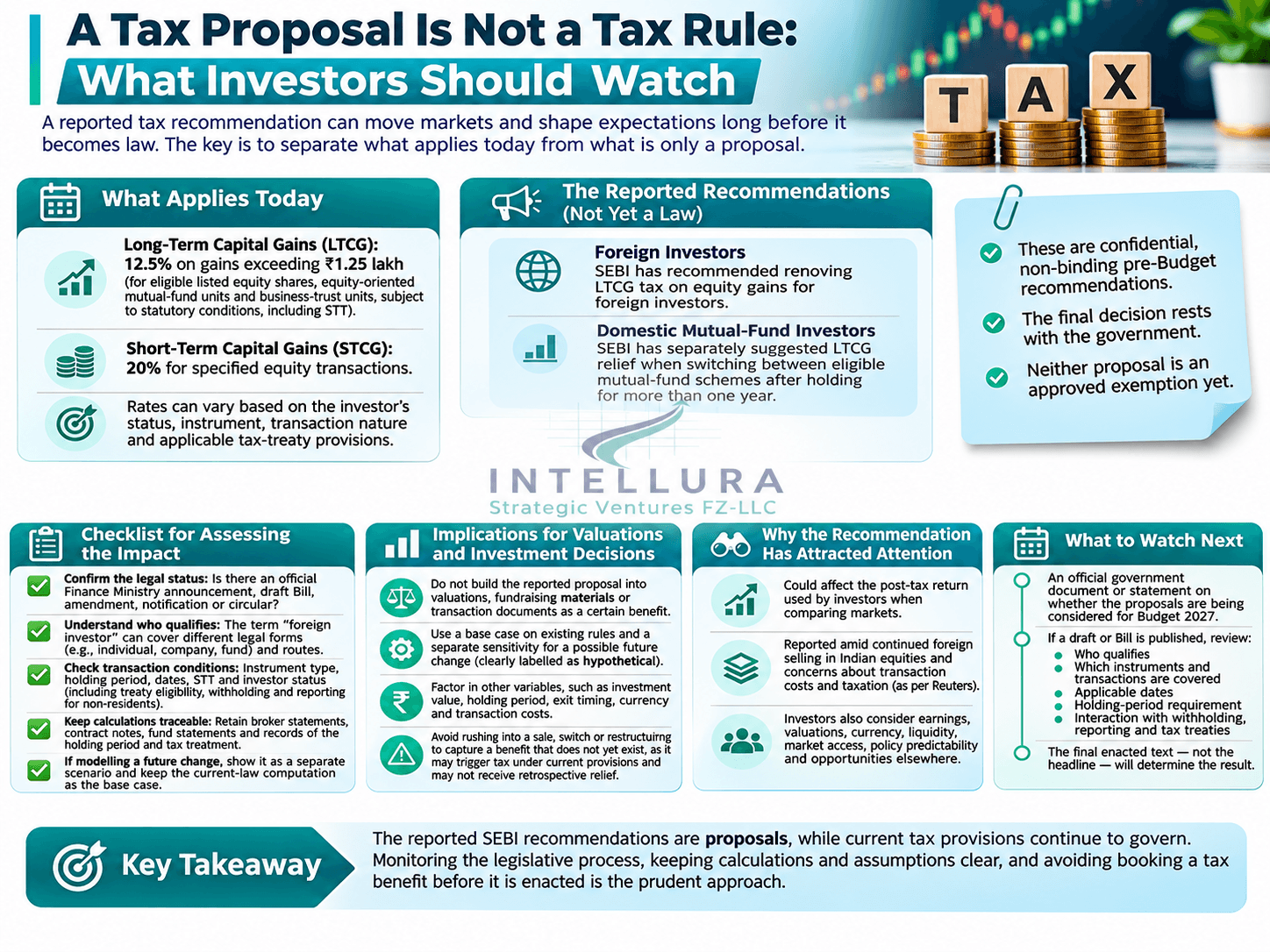
A reported tax recommendation can move markets and shape expectations long before it becomes law. A Chartered Accountant’s first step is to establish what applies today, what has merely been reported and what evidence would be required before changing a tax calculation or investment decision.
Securities and Exchange Board of India (SEBI) had recommended removing long-term capital gains (LTCG) tax on foreign equity investors. The report also described a separate recommendation: domestic mutual-fund investors might receive LTCG relief when switching eligible holdings between schemes after holding them for more than a year. These were described as confidential, non-binding pre-Budget recommendations. The final decision rests with the government; neither proposal should be treated as an approved exemption.
What applies today
For eligible listed equity shares, equity-oriented mutual-fund units and business-trust units, the Income-tax Act, 2025 currently provides for tax at 12.5% on qualifying long-term capital gains exceeding ₹1.25 lakh. The treatment is subject to statutory conditions, including securities transaction tax requirements.
For specified equity transactions that qualify for the short-term capital-gains regime, the current rate is 20%. This distinction matters because the reported SEBI recommendation concerns long-term gains for foreign equity investors, not a general removal of tax on every equity transaction. Short-term gains, dividend taxation, securities transaction tax and other applicable charges are separate matters.
The exact tax outcome can vary with the investor’s legal and tax status, the instrument, the route through which it is held, the date and nature of the transaction, and any applicable treaty provisions. The ₹1.25 lakh threshold and rate should not be applied mechanically to every foreign investor or every security.
Why the recommendation has attracted attention
A change to the tax treatment of foreign equity gains could affect the post-tax return investors use when comparing markets. Reuters reported the recommendation amid continued foreign selling in Indian equities and investor concerns about transaction costs and taxation. That context may explain why the proposal is receiving attention, but it does not establish that tax is the sole reason for investment flows or that removing one tax would automatically bring capital back.
Investors assess expected earnings, valuations, currency movements, liquidity, market access, policy predictability and the availability of opportunities elsewhere. Even if a future law reduced the tax on certain long-term gains, the decision would still depend on the full investment case and any remaining costs or risks.
The key is to label any analysis that uses a proposed exemption as a scenario, not as the current tax position or a guaranteed future benefit.
The mutual-fund suggestion is a separate proposal
The reported idea for domestic mutual-fund investors addresses a different issue. A switch from one mutual-fund scheme to another is generally treated as a redemption from the first scheme and a fresh investment in the next. If a taxable gain arises, the switch may create a tax liability even when the investor keeps the money within the mutual-fund market. Reuters reported that SEBI had suggested LTCG relief for certain switches after a holding period of more than one year.
The report does not establish which schemes, units, switch types or investors would qualify, how losses would be treated, or whether tax would be deferred or permanently exempted. Those details would need to be addressed in an official proposal and, if accepted, in the law and supporting rules. Investors should not assume that a switch is currently tax-free because the recommendation has been reported.
The two ideas should not be combined into one broad claim that “LTCG tax may be removed.” The first concerns foreign equity investors and long-term gains.
checklist for assessing
Start by confirming the legal status. Is there an official Finance Ministry announcement, draft Finance Bill, enacted amendment, notification or circular? A media report about a regulator’s representation is useful for understanding policy discussion, but it is not a substitute for a published legal instrument. Until a change is formally made and its effective date is known, apply the existing rules to transactions and tax provisions.
“Foreign investor” may cover different legal forms and tax categories. The result could depend on whether the investor is a non-resident individual, a foreign company, a fund or another entity, and whether investment is direct or through a pooled vehicle. A future amendment would need to define its scope clearly.
Review the transaction-level conditions before applying an equity rate. These may include the nature of the instrument, its holding period, acquisition and transfer dates, the applicable securities transaction tax condition and the investor’s status. For a non-resident, treaty eligibility, documentation, withholding and reporting may also require review.
Keep calculations traceable. Reconcile broker statements, contract notes, acquisition records, fund statements and tax-withholding documents. Retain evidence of the holding period and the tax classification used. If an investor compares the existing law with a possible exemption, show the assumptions separately and preserve the current-law computation as the base case. This makes the analysis reviewable and avoids mixing a policy scenario with an actual tax provision.
Implications for valuations and investment decisions
Founders, finance teams and investors should be cautious about incorporating the reported recommendation into valuations, fundraising materials or transaction documents. A model that assumes zero LTCG tax could overstate an investor’s post-tax return if the proposal is not adopted or is narrower than expected. If a company discusses the proposal with prospective investors, it should describe the legal status accurately and avoid presenting tax relief as a certainty.
A useful financial model can show more than one outcome. The base case should use the rules currently in force. A separate sensitivity can illustrate a possible future tax change, clearly labelled as hypothetical and subject to legislation. The analysis should also account for other variables, such as investment value, holding period, exit timing, currency and transaction costs. This helps decision-makers understand how much of the investment case depends on a policy outcome.
Investors should also avoid rushing into a sale, switch or restructuring to capture a benefit that does not yet exist. A transaction may trigger tax under current provisions, and later law may not provide retrospective relief. Any decision should be based on the actual law, the investor’s circumstances and the commercial rationale—not on an assumption that a recommendation will become law.
What to monitor next
The next meaningful development would be an official government document or statement clarifying whether the proposals are being considered for Budget 2027. If a draft or bill is published, examine who qualifies, which instruments and transactions are covered, the applicable dates, any holding-period requirement, and how the measure interacts with withholding, reporting and tax treaties. The final enacted text—not the headline—will determine the result.
For now, the prudent position is straightforward: the reported SEBI recommendations are proposals, while current tax provisions continue to govern. Monitoring the legislative process is sensible; booking a tax benefit before it is enacted is not. Clear status labels, carefully supported calculations and documented assumptions allow investors to respond quickly if the rules change without confusing a possibility with an entitlement.