Nifty 50 Today: Market Extends Rally to a Two-Month High
The Nifty 50 surged nearly 5% in four sessions to a two-month high—but can the rally sustain amid volatile crude prices, global uncertainty and shifting investor sentiment?
By CA Aswin
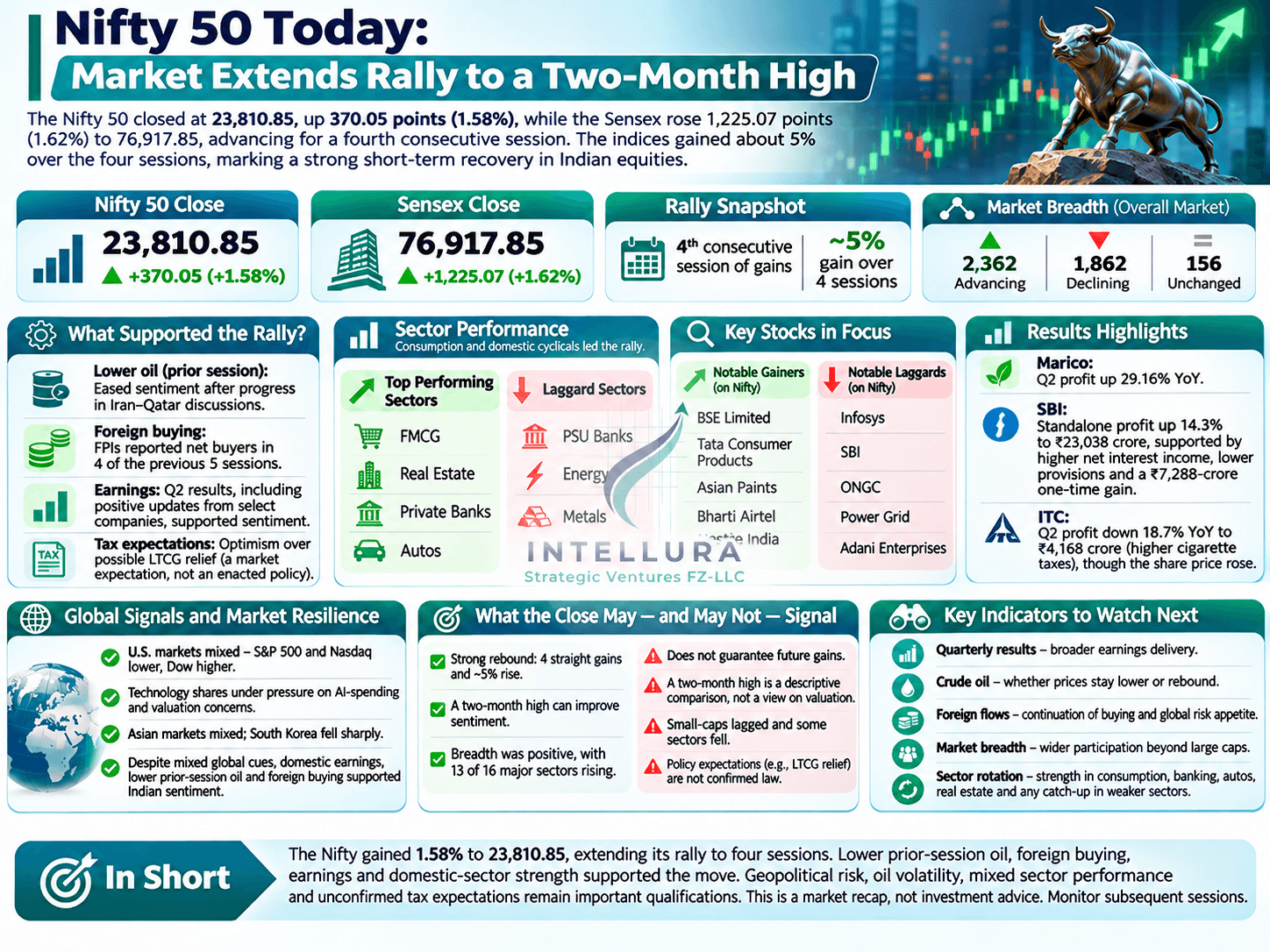
The Nifty 50 closed Tuesday, November 3, at 23,810.85, gaining 370.05 points, or 1.58%, from Monday’s close of 23,440.80. The Sensex rose 1,225.07 points, or 1.62%, to 76,917.85. Both benchmarks advanced for a fourth consecutive session and finished at reported two-month highs. Over the four sessions, the indices had gained about 5%, marking a strong short-term recovery in Indian equities. The 23,810.85 figure is the end-of-session close, not an intraday quote. The 370.05-point gain is measured against Monday’s 23,440.80 finish; the percentage change reflects that prior closing level.
The rally extended beyond the largest Nifty stocks. Business Line reported 13 of 16 major sectors rising; mid-caps gained 1.1% and small-caps 0.3%. Money control recorded 2,362 advancing shares, 1,862 declining and 156 unchanged. These breadth figures cover the wider market. The benchmark outperformed smaller companies, indicating stronger buying in large, liquid shares. The advance in 13 of 16 major sectors gives more evidence of participation than the headline index alone, although the lower small-cap gain shows that the move was not equally strong across market segments.
What supported the rally?
A mix of domestic and external factors supported sentiment. Reports of progress in Iran-Qatar discussions raised hopes of easing tensions and helped crude fall sharply in the previous session. Lower oil can benefit India by easing import costs, inflation pressure and some corporate input expenses. These are potential effects, not guarantees, and depend on prices remaining lower. For Indian markets, oil is an important macro variable because India imports much of its energy requirement. A sustained decline could ease costs, but a one-day move cannot confirm a lasting trend.
Brent crude edged about 1% higher to roughly $106 a barrel on Tuesday after falling around 7% in the previous session. Reports of a US strike on Iran’s Qeshm Island kept supply risks in focus. Oil therefore remained volatile as investors weighed diplomacy against escalation.
Foreign portfolio investors were reported as net buyers in four of the previous five sessions, supporting liquidity. Reports linked some optimism to possible long-term capital-gains tax relief. This was a market expectation, not enacted policy; tax decisions should follow current law and official announcements.
Second-quarter FY 2026–27 results also influenced sentiment. Resilient earnings can support prices, but reactions depend on expectations, valuations and guidance. One strong session does not show that earnings growth will remain broad or continue at the same pace.
Sector performance: consumption and domestic cyclicals lead
Consumer and domestic cyclical sectors led. FMCG, real estate, private banks and autos outperformed, while PSU Bank and Energy indices declined; metals were also weaker. The pattern suggests buying in areas tied to domestic demand and credit, but it does not mean every stock in those sectors advanced. FMCG performance can be sensitive to consumption expectations, while private banks and autos are often monitored for credit growth and consumer demand. Such links offer context, not causal proof for today’s moves.
Sector rankings are only a one-day snapshot. A sector index can rise on gains in a few large constituents even while other members fall. The Nifty’s 1.58% gain is not the return of every constituent or investor portfolio.
Stocks and earnings in focus
Reported Nifty gainers included BSE Limited, Tata Consumer Products, Asian Paints, Bharti Airtel and Nestlé India. Infosys, SBI, ONGC, Power Grid and Adani Enterprises were among the laggards. The list shows mixed stock performance and is not a view on long-term prospects.
Marico shares rose after a reported 29.16% year-on-year increase in consolidated Q2 profit. SBI reported standalone profit up 14.3% to ₹23,038 crore, supported by higher net interest income and lower provisions. The report also noted a ₹7,288-crore one-time gain and lower operating profit, reminders to distinguish recurring performance from exceptional items.
ITC’s consolidated Q2 profit was reported down 18.7% year-on-year to ₹4,168 crore, with higher cigarette-business taxes cited. Its shares nevertheless rose. Prices also reflect expectations, valuation, guidance and positioning, so a results headline alone does not explain a stock’s daily move. The contrast between results and share moves highlights expectations: prices may rise even after a profit decline if the result is less negative than feared, or fall despite profit growth if outlook disappoints.
Global signals and the market’s resilience
The rally came despite mixed global cues. US markets ended unevenly, with the S&P 500 and Nasdaq lower and the Dow higher. AI-spending and valuation concerns weighed on technology shares; Asian markets were mixed, and South Korean stocks fell sharply. Domestic earnings, lower prior-session oil and foreign buying supported Indian sentiment. The contrast matters because Indian equities do not trade in isolation: foreign risk-taking, global rates, technology valuations and dollar movements can alter allocations even when domestic fundamentals remain steady.
Global markets can affect foreign flows, oil, currency and valuations. Investors were also watching US midterm elections. No single headline explains the Nifty’s close: earnings, rates, geopolitical risk and liquidity interact. India’s relative strength does not remove global volatility.
What the close may—and may not—signal
Four consecutive gains and an approximately 5% four-session rise mark a strong rebound. A two-month high may improve sentiment, but a rapid recovery remains vulnerable to profit-taking, weaker earnings or rising oil. A strong close records that day’s buying; it does not guarantee future gains. A two-month high is a descriptive comparison with recent index levels, not an indication that valuation is cheap or expensive. That assessment requires earnings estimates, cash flows and market multiples.
Breadth was positive, though small-caps lagged the benchmark and some sectors fell. Broader participation supported by earnings would strengthen the rally’s foundation; narrow leadership could mask weakness beneath the index. These are conditions to monitor, not forecasts.
Keep policy expectations separate from enacted rules. Possible capital-gains relief is not a government decision; current law remains the basis for tax planning. Assess earnings through operating performance, cash generation and exceptional items, not headline growth alone.
Key indicators to watch next
Next, investors will monitor quarterly results, crude, foreign portfolio flows and geopolitical developments. Broad earnings delivery matters more than isolated announcements. Sustained lower oil could ease import and inflation pressures; a rebound could renew them. Foreign flows will also reflect valuations and global risk appetite. Investors can track whether market breadth improves, crude remains contained, foreign buying persists and upcoming earnings confirm profit momentum. These indicators may help explain trend quality, but they do not predict returns.
Sector rotation is another signal: continued leadership in consumption, banking, autos and real estate would show resilience in domestic-linked shares. Broader gains in smaller companies or currently weak sectors would need confirmation across later sessions. A balanced review should also compare the Nifty with other benchmarks and the investor’s own time horizon. The daily percentage change is a useful snapshot, but not a complete measure of portfolio performance or risk.
the Nifty gained 1.58% to 23,810.85, extending its rally to four sessions. Lower prior-session oil, foreign buying, earnings and domestic-sector strength supported the move. Geopolitical risk, oil volatility, mixed sector performance and unconfirmed tax expectations remain important qualifications. This is a market recap, not investment advice. Monitor subsequent sessions.